LACMA — Los Angeles County Museum of Art

BEAUFORD DELANEY (1901-1979)
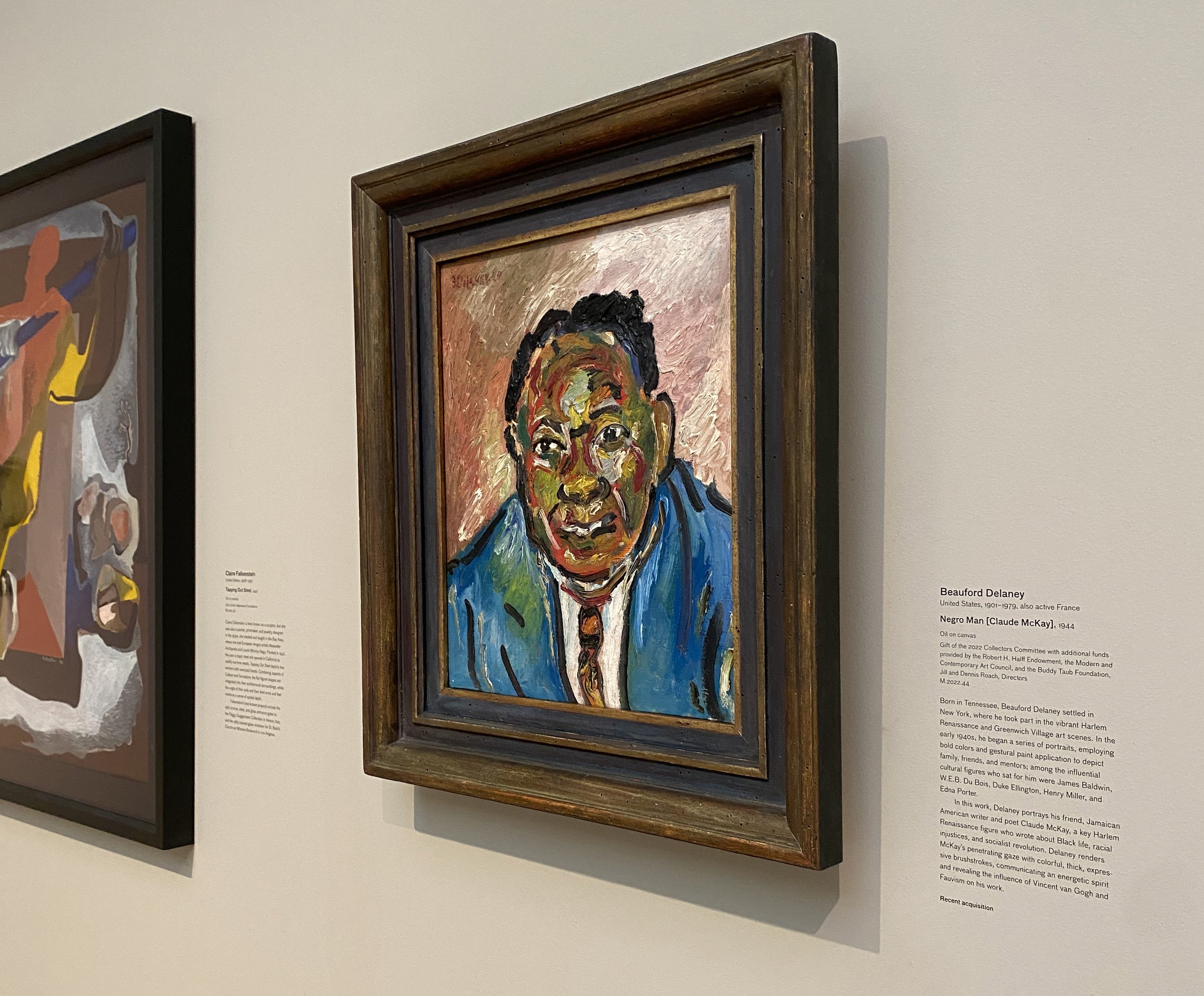
Negro Man [Claude McKay], 1944, oil on canvas, 19-1/8” x 16-1/4” Period c. 1940s-50s American Modernist frame, gilded and painted wood, molding width 4-1/8”
“Beauford Delaney, one of the most important Black artists of the 20th century, painted this rare portrait of his friend, the well-known Jamaican American writer and poet Claude McKay (1889–1948) when both lived in New York. Delaney’s practice intersects with much of 20th-century American art: the Harlem Renaissance, the circle around modernists Alfred Steiglitz and Georgia O'Keeffe, American urban scene painting, and Abstract Expressionism.
Negro Man [Claude McKay] is an intimate portrait of one of the most influential figures of the Harlem Renaissance. Central to the movement were artists, writers, and intellectuals who represented a new, confident, and vibrant Black expression and self-determination. Many pioneering members of the cultural movement, like Delaney and McKay, were LGBTQ, including Richmond Barthé, Countee Cullen, Langston Hughes, Alain Locke, and Bessie Smith. In his writings, McKay recorded his radical views on the injustices of Black life in America and his belief in the importance of Black autonomy through socialist revolution.
Delaney renders his friend McKay’s pensive countenance with colorful, thick, expressive brushstrokes that delineate the contours and shadows of his face. Dressed in a bright blue jacket, McKay gazes directly at us; his upper torso fills the canvas, suggesting his powerful presence. Stylistically, the thick brushwork and intense colors reveal Delaney’s appreciation for Van Gogh and the French Fauves. Working from both direct observation and memory, Delaney’s psychologically engrossing portrait captures his sitter’s temperament through details of clothing and expression, set against a textured abstract background.
Delaney emigrated to Paris in the 1950s, following his friend, writer James Baldwin, and joining a community of Black American writers, artists, and musicians who found Paris more accepting and less discriminatory to Blacks and homosexuals. In Paris his work turned more abstract and gestural, which would be his prevailing style for the remainder of his life.” —LACMA curatorial notes