
LOS ANGELES TIMES
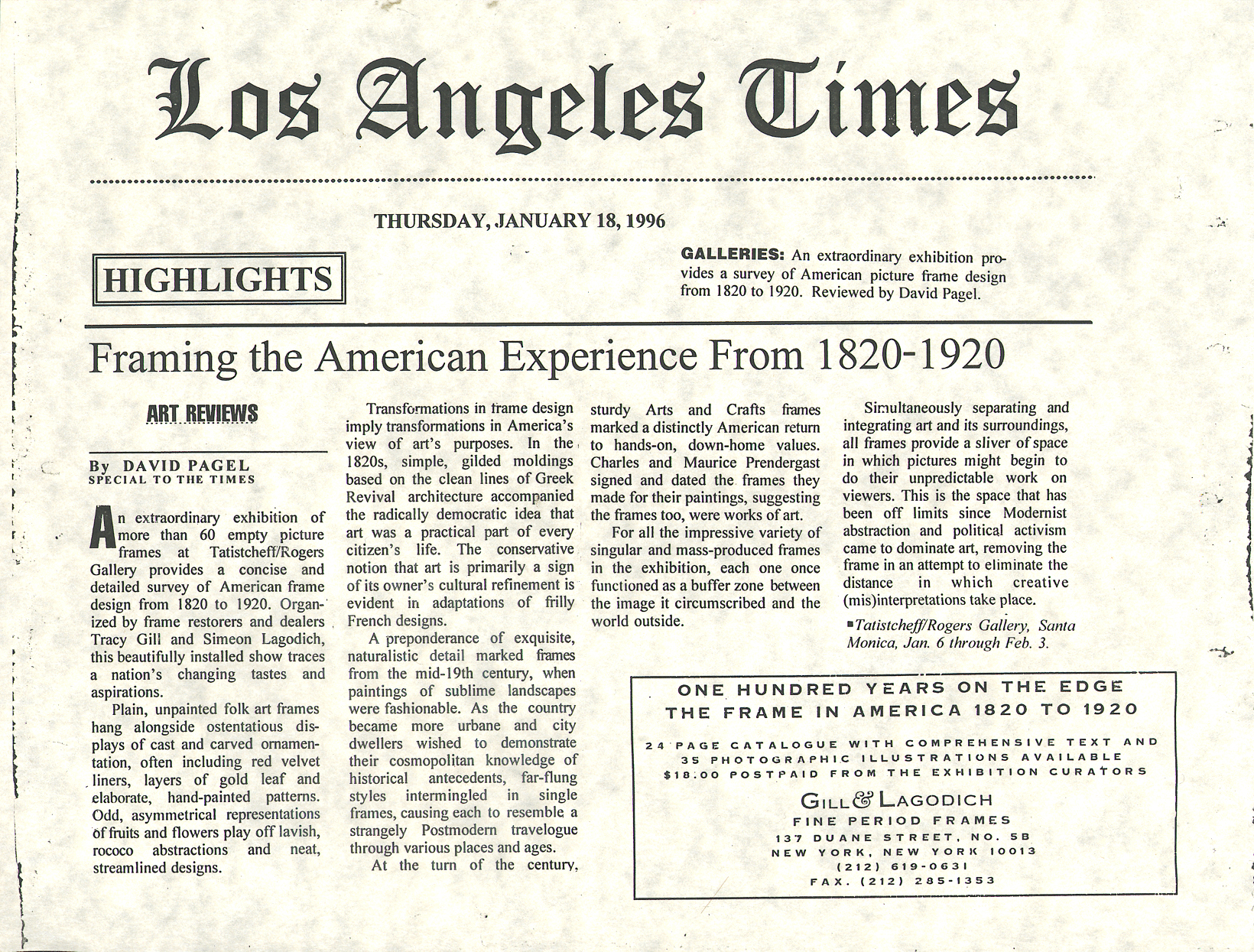
Los Angeles Times, January 18, 1996
Framing the American Experience from 1820–1920
An extraordinary exhibition of more than 60 empty picture frames at Tatistcheff/Rogers Gallery provides a concise and detailed survey of American frame design from 1820 to 1920. Organized by frame restorers and dealers Tracy Gill and Simeon Lagodich, this beautifully installed show traces a nation’s changing tastes and aspirations.
Plain, unpainted folk art frames hang alongside ostentatious displays of cast and carved ornamentation, often including red velvet liners, layers of gold leaf and elaborate, hand-painted patterns. Odd, asymmetrical representations of fruits and flowers play off lavish, rococo abstractions and neat, streamlined designs.
Transformations in frame design imply transformations in America’s view of art’s purposes. In the 1820s, simple, gilded moldings based on the clean lines of Greek Revival architecture accompanied the radically democratic idea that art was a practical part of every citizen’s life. The conservative notion that art is primarily a sign of its owner’s cultural refinement is evident in adaptations of frilly French designs.
A preponderance of exquisite, naturalistic detail marked frames from the mid-19th century, when paintings of sublime landscapes were fashionable. As the country became more urbane and city dwellers wished to demonstrate their cosmopolitan knowledge of historical antecedents, far-flung styles intermingled in single frames, causing each to resemble a strangely Postmodern travelogue through various places and ages.
At the turn of the century, sturdy Arts and Crafts frames marked a distinctly American return to hands-on, down-home values. Charles and Maurice Prendergast signed and dated the frames they made for their paintings, suggesting the frames too, were works of art.
For all the impressive variety of singular and mass-produced frames in the exhibition, each one once functioned as a buffer zone between the image it circumscribed and the world outside.
Simultaneously separating and integrating art and its surroundings, all frames provide a sliver of space in which pictures might begin to do their unpredictable work on viewers. This is the space that has been off limits since Modernist abstraction and political activism came to dominate art, removing the frame in an attempt to eliminate the distance in which creative (mis)interpretations take place.
* Tatistcheff/Rogers Gallery, 2042 Broadway, Santa Monica, (310) 449-1240, through Feb. 3. Closed Sundays and Mondays.